What Is a Building Management System? A Practical Guide
A building management system (BMS) is a central control system used to monitor and manage a building’s mechanical and electrical services. It gives building owners, facility managers and service teams one place to see how equipment is operating, investigate faults and adjust the way plant runs.
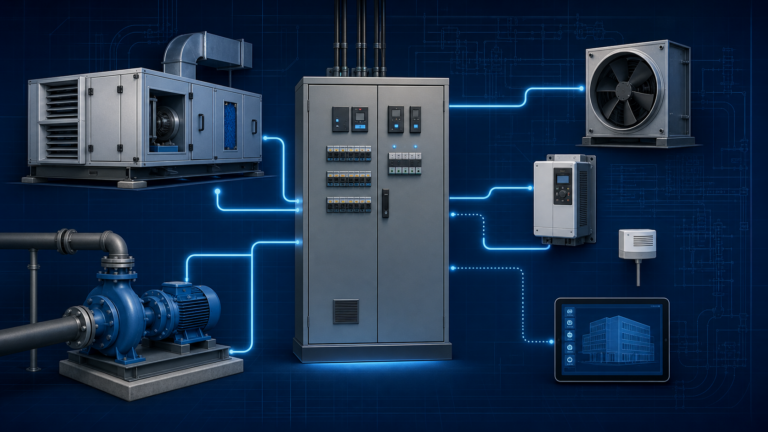
In a typical commercial building, a BMS may supervise air-handling units, heat pumps, chillers, boilers, ventilation systems, pumps, variable-speed drives, meters and environmental sensors. Instead of treating each item as an isolated piece of equipment, the BMS brings information and control together in one coordinated platform.
What does a BMS actually do?
At its simplest, a BMS reads information from the building, applies programmed control logic and sends commands to connected equipment. For example, it may read a room temperature, compare it with the required setpoint and adjust a valve, fan or heat-pump command to maintain comfortable conditions.
- Monitor temperatures, humidity, pressure, air quality and equipment status
- Start and stop plant according to occupancy schedules
- Control valves, dampers, fans, pumps and variable-speed drives
- Generate alarms when equipment fails or conditions move outside acceptable limits
- Record trends so performance can be reviewed over time
- Present information through graphical dashboards
- Coordinate multiple systems to reduce unnecessary energy use
The main parts of a building management system
Sensors and field devices
Sensors measure what is happening throughout the building. Common examples include temperature sensors, humidity sensors, carbon-dioxide sensors, pressure transmitters, water-leak detectors and electrical meters. Other field devices provide run, fault and position feedback from equipment.
Controllers
Controllers receive the field information and carry out the control sequence. Some controllers manage a single item, such as a fan-coil unit, while others control larger plant such as air-handling units, central heating systems or chilled-water systems.
Networks and communication protocols
The controllers and equipment communicate across a network. Open protocols such as BACnet and Modbus are widely used because they can allow equipment from different manufacturers to share information. Even with an open protocol, the point list, equipment capabilities, configuration and commissioning still determine whether the integration is useful.
Supervisory software and graphics
The BMS front end turns technical data into usable information. Operators can view plant graphics, acknowledge alarms, adjust authorised settings, review trends and check whether systems are following the intended operating sequence.
Which building systems can be connected?
The exact scope varies from project to project. HVAC controls are usually at the centre of a commercial BMS, but a well-designed system can also exchange information with electrical metering, lighting controls, heat-pump or VRF systems, generators, solar systems, EV charging, access control and other specialist platforms.
Integration does not necessarily mean that one system takes complete control of another. Often the safest approach is to exchange selected commands, status points and alarms while each specialist system retains responsibility for its own critical functions.
How can a BMS reduce energy use?
A BMS does not save energy simply because it is installed. The savings come from appropriate control strategies, accurate sensors, realistic schedules and ongoing attention to how the building is actually used.
- Stopping equipment when areas are unoccupied
- Resetting temperature or pressure targets as demand changes
- Varying fan and pump speed instead of running equipment at full output
- Coordinating heating and cooling so they do not operate against each other
- Using outside-air conditions when free cooling is available
- Identifying abnormal consumption through metering and trends
- Finding failed sensors, leaking valves or overridden controls before the problem becomes permanent
Why alarms and trends matter
Good alarms tell the right person about a meaningful problem. Poorly configured systems can produce hundreds of low-value alarms, which makes important faults easier to miss. Alarm priorities, delays and routing should therefore match the operational risk.
Trend logs provide the history needed to diagnose intermittent faults and verify performance. A technician can compare temperatures, commands, valve positions and fan speeds over the same period rather than relying only on what the system is doing at the moment they arrive.
BMS versus home automation
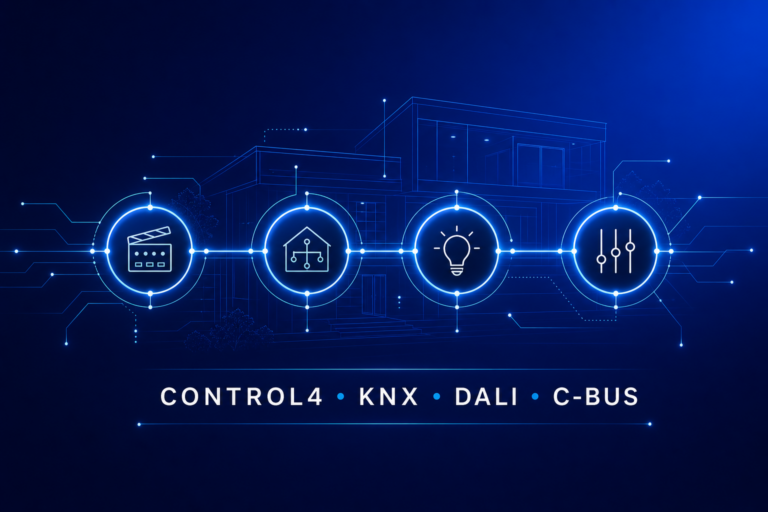
Building management systems and home automation share some ideas, but their priorities are different. A commercial BMS usually focuses on HVAC plant, energy, alarms, maintainability and the needs of facility teams. Home automation typically places more emphasis on lighting scenes, blinds, entertainment, security, comfort and a simple homeowner experience.
The two fields increasingly overlap. High-end homes may have sophisticated energy and HVAC control, while modern commercial buildings may include app-based room controls and personalised user experiences. The architecture needs to suit the property, the people operating it and whoever will support it later.
What should you consider before installing or upgrading a BMS?
- Define the outcome. Decide whether the priority is comfort, reliability, visibility, energy reduction, replacement of obsolete equipment or a combination of these.
- Document the existing systems. Confirm the plant, controls, communication protocols, field devices and available records.
- Agree on the control philosophy. Clear sequences of operation are essential for pricing, programming, commissioning and future maintenance.
- Consider openness and support. Think about product availability, cybersecurity, licensing, remote access and who will support the system over its life.
- Plan the commissioning. Every sensor, output, alarm, interlock and operating sequence should be tested—not merely shown as connected.
Is a BMS suitable for an existing building?
Often, yes. An upgrade can be staged to suit operational constraints and budget. Some projects replace only the head-end software or obsolete controllers; others retain usable field wiring and devices while progressively upgrading plant controls. A site assessment is needed to determine what can be reused safely and what is likely to create ongoing risk.
Frequently asked questions
Does every commercial building need a BMS?
No. The value generally increases with the size and complexity of the plant, operating hours, energy use and need for central monitoring. A smaller building may be better served by simpler controls, provided they are well designed and commissioned.
Can a BMS work with equipment from different manufacturers?
Frequently, but compatibility should be confirmed during design. A protocol label alone does not guarantee that every required point, command or function is available.
How often should a BMS be maintained?
The appropriate frequency depends on the building and criticality of its services. Regular reviews should include alarms, overrides, sensor accuracy, trend data, schedules, backups and system security—not only reactive fault repairs.
Talk to Syntra about your building
Syntra works across building management systems, HVAC controls, electrical for mechanical, energy monitoring and integrated automation. Whether you are planning a new system, investigating an upgrade or trying to understand an existing installation, we can review the plant, controls and records and work out the next useful step.
Technical source. Prepared from Syntra’s practical electrical and controls experience, spanning installation, automation, commissioning and building operation. See the experience behind Syntra.